
To write a good law enforcement resume, you’ll need to show how you excel at promoting public safety and order. The tips and examples below will help you capture this skill on your resume so it gets you interviews for your next law enforcement job.
“Law enforcement resumes should focus on public safety, conflict de-escalation, and investigative skills. Show your integrity and readiness.”

Most Popular Law Enforcement Resumes
Entry-Level Law Enforcement Resume

Mid-Career Law Enforcement Resume

Senior-Level Law Enforcement Resume

Patrol Officer Resume

Why This Resume Stands Out
Alex quantifies calls handled and recognitions earned, demonstrating both volume and excellence in community policing.
Senior Patrol Officer Resume

Why This Resume Stands Out
Taylor’s resume links case closures and program outcomes to community safety improvements, showing leadership in prevention.
Federal Law Enforcement Agent Resume

Why This Resume Stands Out
Jordan’s resume quantifies seizures and convictions, demonstrating tangible federal enforcement results.
Corrections Officer Resume

Why This Resume Stands Out
Morgan’s resume highlights incident de-escalation counts and contraband seizures, evidencing hands-on security work.
Criminal Investigator Resume

Why This Resume Stands Out
Casey’s resume demonstrates clear case-resolution metrics and specialized digital forensics expertise.
K-9 Handler Resume

Why This Resume Stands Out
Drew’s resume quantifies canine recoveries and certification rates, proving handler proficiency.
School Resource Officer Resume

Why This Resume Stands Out
Chris’s resume ties program metrics directly to conflict-reduction percentages, illustrating proactive safety work.
Detective Sergeant Resume

Why This Resume Stands Out
Pat’s resume exhibits management of large caseloads and high clearance rates, showcasing leadership in major crimes.
Tactical Operations Specialist Resume

Why This Resume Stands Out
Sam’s resume combines operational counts with perfect safety records, illustrating tactical proficiency.
Criminal Intelligence Analyst Resume

Why This Resume Stands Out
Jamie’s resume quantifies link-analysis outcomes and crime reductions, showing strategic intelligence value.
Harbor Patrol Officer Resume

Why This Resume Stands Out
Alex’s resume pairs citation counts with rescue missions, demonstrating both enforcement and lifesaving capabilities.
Juvenile Probation Officer Resume

Why This Resume Stands Out
Taylor’s resume ties caseload metrics to recidivism drops, underscoring effective probation strategies.
Key Tip
Highlight recidivism improvements to showcase program efficacy. For further insight, see How to Put Volunteer Work on a Resume.
Metro Transit Police Officer Resume

Why This Resume Stands Out
Jordan’s resume highlights measurable reductions in transit incidents and strong event-based coordination.
Crime Scene Investigator Resume

Why This Resume Stands Out
Morgan’s resume connects scene processing volume to prosecution improvements, showcasing forensic impact.
Forensic Examiner Resume

Why This Resume Stands Out
Casey’s resume ties high sample volume and accuracy rates to lab efficiency gains.
Wildlife Enforcement Officer Resume

Why This Resume Stands Out
Drew’s resume quantifies citations and outreach events, illustrating an enforcement and education balance.
Highway Patrol Officer Resume

Why This Resume Stands Out
Chris’s resume links citation volume and reconstruction improvements, showcasing both enforcement and technical skills.
Cybercrime Investigator Resume

Why This Resume Stands Out
Pat’s resume quantifies case success rates and interagency work, underlining technical and collaborative strengths.
Evidence Technician Resume

Why This Resume Stands Out
Sam’s resume demonstrates strong evidence-management metrics and digitization gains.
Mounted Patrol Officer Resume

Why This Resume Stands Out
Jamie’s resume pairs large-scale crowd metrics with equine-unit readiness, showcasing specialized patrol abilities.
Narcotics Detective Resume

Why This Resume Stands Out
Alex’s resume ties seizure values and conviction rates to undercover successes, underscoring investigative prowess.
Our templates are crafted by professional resume writers to make creating your resume quick, easy, and effective.
- Professional resume template downloads
- Customized cover letter generation
- AI resume writing support
- Career-building resources and advice
Law Enforcement Text-Only Resume Templates and Examples
How To Write a Law Enforcement Resume
Law enforcement resumes should open with your role, jurisdiction, and primary focus. I want to know quickly whether you are patrol, investigations, or something specialized, plus a short nod to community engagement, de escalation, or commendations so I can trust your judgment before reading the rest.

1. Summarize your law enforcement qualifications in a dynamic profile
Your resume profile should catch hiring managers’ attention by giving the key reasons they can rely on you to help maintain public safety. Maybe you have experience protecting and engaging with a similar community for many years. Or perhaps you’ve outperformed other officers in your department by an impressive margin. Also, consider naming your top knowledge areas – for example, your unusually strong grasp of surveillance technology or traffic laws. These are great assets to feature in your profile if they overlap with your target law enforcement job.
Entry-Level Profile Example
Dedicated criminal justice graduate with experience as a security specialist preventing and recovering store losses. Recognized for working with team members to build and maintain a safe, secure environment. Skilled at using video surveillance footage to help gather and evaluate evidence. Thrive in fast-paced and challenging work settings.
Mid-Career Profile Example
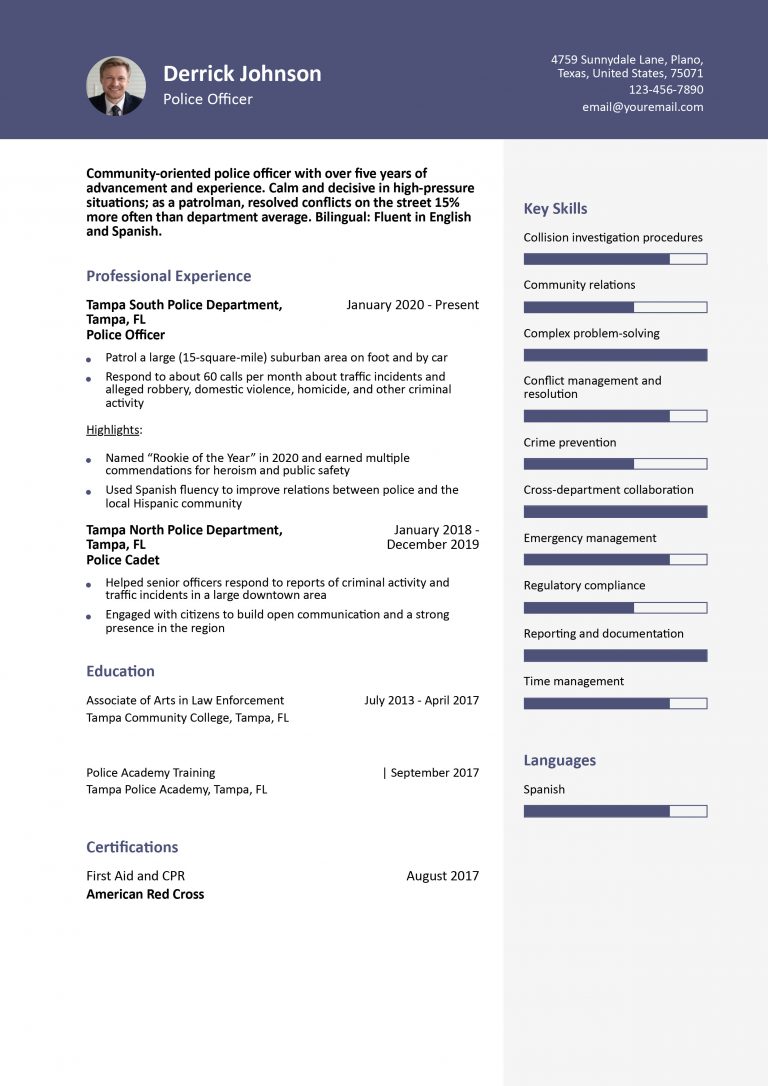
Community-oriented police officer with over five years of advancement and experience. Calm and decisive in high-pressure situations; as a patrolman, resolved conflicts on the street 15% more often than the department average. Bilingual: Fluent in English and Spanish.
2. Add your law enforcement experience with compelling examples
With the experience section, show you’re well-qualified for law enforcement by giving examples of your success in protecting the general public. Under each law enforcement job in your recent work history, describe how you made a positive impact and what you were praised for most by your superiors. For instance, maybe you used your fluency in a foreign language to build better community relations. Or perhaps you closed many cases or co-developed a program that reduced crime by a certain percentage. By adding detailed examples like these, you’ll give hiring managers a sense of the value you’d generate in their open law enforcement position.
Experience Example
Police Officer, Tampa South Police Department, Tampa, FL | January 2020 to present
- Patrol a large (15-square-mile) suburban area on foot and by car
- Respond to about 60 calls per month about traffic incidents and alleged robbery, domestic violence, homicide, and other criminal activity
Highlights:
- Named “Rookie of the Year” in 2020 and earned multiple commendations for heroism and public safety
- Used Spanish fluency to improve relations between police and the local Hispanic community
3. List any education and certifications relevant to law enforcement
Use the Education and Certifications sections to show your law enforcement work has a strong knowledge base. Give basic details on the highest degree you’ve earned, along with any coursework, majors, or minors in criminal justice. Also, consider naming the training academy you attended as part of your preliminary work experience.
Below are templates and examples to help you format your education and certification details. Note that optional template items appear in [brackets].
Education
Template
- Degree Name — [Major, Minor], School Name, City, ST | [Year]
- [#.# GPA] | [academic honors or awards]
Example
- Associate of Arts — Law Enforcement, Tampa Community College, Tampa, FL | 2017
Certification
Template
- Certification Name or Title, [Awarding Organization] | [Year]
Example
- First Aid and CPR, American Red Cross | 2017
4. Outline your most useful law enforcement skills and proficiencies
Add a “key skills” section to show employers how you keep people safe and property secure. These can range from direct crime prevention to more general duties like reporting or community relations – just make sure each one overlaps with your target law enforcement job. Below are some common skills and keywords to consider for your resume:
| Key Skills and Proficiencies | |
|---|---|
| Collision investigation procedures | Community relations |
| Complex problem-solving | Conflict management and resolution |
| Crime prevention | Criminal investigation |
| Cross-department collaboration | Emergency management |
| Evidence gathering and analysis | Interview and interrogation methods |
| Regulatory compliance | Reporting and documentation |
| Search and seizure | Security operations |
| Team leadership | Time management |
| Undercover operations | |
How To Pick the Best Law Enforcement Resume Template
As with most vocations, law enforcement professionals should use a resume template that’s clear and straightforward. Opt for a visual design that lets the hiring manager quickly review your best career details. Select a traditional resume font, and avoid any template with an overly colorful or elaborate design.
Frequently Asked Questions: Law Enforcement Resume Examples and Advice
Why should I use a Law Enforcement resume example as a template for my own resume?-
A Law Enforcement resume example provides a solid foundation for structuring your own resume. It showcases how to highlight achievements, use quantifiable metrics, and present your experience in an organized manner. You can personalize it by adding your unique qualifications and adjusting sections to better reflect your skills and career history.
What are common action verbs for law enforcement resumes? -
For law enforcement workers, the best resume verbs will show how you’ve enhanced safety and security – for example, “monitored,” “protected,” or “investigated.” But there are various others you might use to describe your duties and contributions in this field. The following list can help you find the right mix of action verbs for your law enforcement resume:
| Action Verbs | |
|---|---|
| Adapted | Analyzed |
| Apprehended | Assisted |
| Communicated | Conducted |
| Consulted | Created |
| De-escalated | Detained |
| Enforced | Established |
| Evaluated | Gathered |
| Improved | Interrogated |
| Interviewed | Investigated |
| Issued | Led |
| Maintained | Managed |
| Mediated | Monitored |
| Obtained | Organized |
| Patrolled | Prepared |
| Protected | Redirected |
| Researched | Resolved |
| Responded | Searched |
| Secured | Served |
| Strengthened | Supervised |
| Testified | Trained |
How do you align your law enforcement resume with a job posting?-
The Bureau of Labor Statistics forecasts that jobs for police and detectives will increase by about 3% between 2021 and 2031.
You can get more interviews in this field if you tailor your resume for each application. Start by looking at the job post text and highlighting words or phrases that are repeated, emphasized, or otherwise seem important. Compare these highlighted phrases against the language you’re using in your resume, particularly the profile and key skills sections. Then look for ways to align your resume language with the job post while not copying phrases or misrepresenting your background.
For example, if the hiring agency wants someone with a strong collaborative streak, you may want to call out that aspect of your experience with a profile line as simple as “Thrive in collaborative work settings.” Or, say, the police force or organization engages with many non-English speaking partners and community members. You can highlight your foreign language skills both in your profile and as a separate section farther down the document. With adjustments like these, you can make your resume more relevant to each new job opportunity.
“Courage is not the absence of fear, but the triumph over it. Step into the honorable journey of law enforcement, where bravery meets service in the pursuit of a safer society,” says expert recruiter Ernestine Council.
What is the best law enforcement resume format? -
In nearly all cases, use a Combination (or Hybrid) resume because it’s easiest for hiring managers to learn about your pertinent skills and experience. It’s also simplest for you to modify based on your job goals.
With the Combination format, you highlight your most relevant skills and experience in your Experience or Work History section and an intro section. (This combination of work history and intro content is where the format gets its name.) Your resume intro should include a profile summary and key skills section, but you may also add a Career Highlights or Awards section.
Should my law enforcement resume be one or two pages?-
Your law enforcement resume should ideally be one page, especially if you have fewer than 10 years of experience. A two-page resume can be effective for seasoned professionals with a longer track record if it highlights accomplishments and skills directly relevant to the job. Every detail should add value and strengthen your candidacy.
Limit your work experience to the past 10 to 15 years, unless earlier positions are highly relevant. Keeping your resume concise and targeted will make a strong and memorable impression on potential employers.
Craft your perfect resume in minutes
Get 2x more interviews with Resume Builder. Access Pro Plan features for a limited time!

To increase your chances of an interview, write and submit a strong cover letter. The key to an effective letter is customizing it based on each job opening. Read our law enforcement cover letter guide to learn how. For other related examples, see our police officer and security officer cover letter guides.