In This Guide
- Resumes in 2026 should use a clean, ATS-friendly format, focus on relevant experience and measurable results, and highlight current skills, including AI skills when relevant.
- AI and applicant tracking systems (ATS) are changing how resumes are screened, making clear qualifications, job-relevant keywords, and targeted content increasingly important.
- Outdated resume practices, such as including photos, using overdesigned templates, listing references, including your entire career history, and highlighting obsolete skills, can take up valuable space without strengthening your application.
Landing a job in 2026 means navigating a hiring process shaped by both AI tools and human judgment. More employers use ATS tools and AI to organize applications, identify relevant qualifications, and streamline screening, making it harder to know what actually gets a resume noticed. At the same time, recruiters still need clear evidence of what you’ve accomplished and the value you can bring to a role.
This guide breaks down current resume trends for 2026, including what’s working, what’s changing, and what’s no longer effective. You’ll learn how to adapt your resume while keeping your experience clear, credible, and focused on your impact.
The 2026 Hiring Landscape: Heavy Competition, AI, & ATS
The 2026 hiring process is more competitive and increasingly shaped by automation. One-click applications and AI-powered job-search tools make it easier for candidates to apply at scale, while employers use ATS and other screening software to manage large applicant pools.
As a result, job seekers need resumes that ATS software can parse easily, are tailored to the role, and are clear enough for recruiters to understand quickly.
How 1-Click Applications Changed the Rules
One-click applications and candidate-side AI tools have made applying faster, allowing candidates to submit more applications with less effort.
Candidates can reuse their information across multiple applications, identify openings faster, and automate parts of the application process. This convenience can create large applicant pools, particularly for remote and highly competitive roles.
When hundreds of resumes arrive for one opening, recruiters need screening tools to narrow the pool before spending time on individual applications. Screening software helps them:
- Organize applications so recruiters can manage large candidate pools.
- Identify relevant qualifications based on skills, experience, and other criteria.
- Narrow the applicant pool before recruiters spend time reviewing resumes individually.
- Search for specific qualifications when filling roles with particular requirements.
This doesn’t mean recruiters intentionally overlook applicants or try to make hiring impersonal. They simply need a way to manage application volume efficiently. For job seekers, that makes it more important to write a resume that clearly presents relevant qualifications so both screening software and recruiters can identify them quickly.
How Modern ATS & AI Software Actually Read Your Resume
Modern ATS software converts resume content into structured or searchable information, including job titles, employers, dates, skills, and other qualifications. Newer AI-assisted screening tools can also evaluate the relationship between skills and experience, making relevant context more useful than simply repeating keywords throughout a resume.
An ATS doesn’t necessarily interpret a resume the same way a person does. Depending on the system, it may extract and organize resume content into fields that help recruiters search, sort, and compare candidates. Clear section headings, conventional job titles, readable dates, and straightforward formatting make that information easier to identify.
When screening software evaluates a resume, relevant information can include:
- Job titles and employers: Show where and in what capacity you gained experience.
- Dates and employment history: Establish your career timeline and level of experience.
- Skills and qualifications: Match your background with the requirements of the role.
- Context around skills: Shows how you actually used a skill rather than simply listing it.
- Accomplishments and responsibilities: Give recruiters evidence of what you contributed in previous roles.

Tip!
Tip!
ATS optimization isn’t about writing for a machine at the expense of a recruiter. Keyword matching still matters, but stuffing a resume with repeated terms isn’t a reliable strategy. For example, listing “project management” several times provides less context than showing how you used project management skills to manage a timeline or deliver a measurable result.
How Job Seekers Must Adapt to Get Noticed
Job seekers should use simple, modern resume formatting and tailor their content to each relevant job description. A clean layout with standard headings, readable fonts, conventional section organization, and limited visual elements helps ATS software extract content accurately while keeping the resume easy for recruiters to review.
Here are a few key tips to consider when creating your resume:
- Use the employer’s terminology when it accurately describes your experience, rather than using different wording that could make relevant qualifications harder to identify.
- Tailor your resume beyond adding keywords. Your work history should show where you used relevant skills and what you accomplished with them.
- Avoid complex designs that depend heavily on text boxes, graphics, multiple columns, icons, charts, or decorative elements to communicate important information. These features can make resume content harder for some systems to extract or interpret.
What Works in 2026: 6 Essential Resume Upgrades
Recent resume trends news highlights that the most effective resumes in 2026 are easy to scan, tailored to the job, and focused on evidence rather than keywords alone.
Update your resume by using an ATS-friendly layout, a targeted summary, measurable accomplishments, relevant AI skills, job-specific keywords, and consistent information across your resume and professional profiles like LinkedIn.
1. Use an ATS-Friendly Resume Layout
A clean, single-column layout with standard headings makes your resume easier for ATS software to parse and recruiters to scan. Use a conventional structure, readable fonts, and clear spacing instead of design elements that can interfere with text extraction.
Keep it simple:
- Use standard headings, such as “Work Experience,” “Education,” and “Skills.”
- Keep important information in the main body of the resume.
- Avoid excessive graphics, charts, icons, and text boxes.
- Use a consistent format for job titles, employers, and dates.
2. Replace Generic Objectives With a Targeted Summary
A strong professional summary quickly tells employers who you are, what you specialize in, and what you bring to the role. Instead of using a generic objective statement, tailor your summary to the position by highlighting your most relevant skills, experience, and accomplishments.
A generic objective focuses on what the candidate wants rather than what they offer:
Experienced marketing professional seeking a challenging position with a growing organization. Looking to apply communication and project management skills in a collaborative work environment. Eager to contribute to company goals while continuing to develop professionally.
A targeted summary gives the recruiter a clearer picture of the candidate’s value:
Marketing manager with 8+ years of experience developing B2B campaigns, leading cross-functional teams, and managing six-figure marketing budgets. Increased qualified leads by 32% through targeted content and paid media campaigns while reducing customer acquisition costs by 18%. Experienced in translating marketing strategy into measurable growth across digital and demand-generation channels.
3. Turn Job Duties Into Measurable Accomplishments
Strong resume bullets show what you accomplished, not just what you were responsible for. Whenever possible, include numbers that demonstrate the scale or outcome of your work.
Specific results give recruiters stronger evidence of your capabilities than broad statements about your responsibilities.
Instead of:
Managed customer service operations and trained employees.
Try:
Managed customer service operations for a 15-person team and reduced average response time by 25%.
Useful metrics can include:
- Revenue or cost savings
- Percentage increases or decreases
- Team size
- Project budgets
- Customer or account volume
- Time saved
- Production or efficiency gains
Tip!
Tip!
Not every accomplishment will have an obvious number. When exact metrics aren’t available, use strong action verbs to describe the scope, outcome, or improvement as specifically as possible without estimating or exaggerating.
4. Highlight Relevant AI Skills & Experience
AI skills are increasingly relevant across many occupations, but present them in the context of actual work rather than as a list of trendy tools. Include AI platforms, automation tools, or AI-related skills when they’re relevant to the position, and explain how you used them to improve a process, solve a problem, or produce an outcome.
You can include AI skills in the skills section of your resume, for example:
- Generative AI: ChatGPT, Microsoft Copilot, Google Gemini
- AI-assisted content development
- Prompt engineering
- AI-powered data analysis
- Workflow automation
- AI-enhanced research and content optimization
And then back up your skills with measurable results in your work history section:
- Used ChatGPT and Microsoft Copilot to develop campaign concepts and draft content variations, reducing initial content production time by 30%.
- Applied AI-powered data analysis to identify audience trends and optimize email campaigns, increasing average click-through rates by 18%.
- Automated routine content research and reporting workflows with AI tools, saving about 8 hours per month and freeing up time for strategic campaign planning.
5. Integrate Keywords Without Stuffing Them
Use relevant keywords from the job description when they accurately describe your experience. This helps screening systems identify qualifications while making it easier for recruiters to see that your background matches the position.
Focus on the employer’s actual requirements rather than adding every keyword you can find, and look for repeated terms related to:
- Required skills and technical tools
- Job titles and areas of specialization
- Certifications or credentials
- Industry terminology
- Core responsibilities
For example, if a posting specifically asks for Salesforce administration, a candidate with that experience should use “Salesforce” and “Salesforce administration” where appropriate rather than relying only on a broader term such as “customer relationship management (CRM).”
6. Align Your Resume & LinkedIn Profile
Your resume and LinkedIn profile should tell a consistent professional story in 2026. Recruiters may review both during the hiring process, so differences in job titles, employment dates, employers, or major accomplishments can create unnecessary questions.
Keep your core career history consistent while adapting each platform to its purpose. Your LinkedIn profile can provide more context than your resume, including a longer “About” section, additional accomplishments, projects, recommendations, and skills. Your resume should remain focused on the experience most relevant to the specific position.
Before applying, check that your resume and LinkedIn profile have consistent job titles and employment dates, employers and career history, certifications and credentials, major accomplishments, and current professional focus.
Tip!
Tip!
Include your LinkedIn URL in your resume header so recruiters can easily find your profile. Use a clean, customized URL when possible, and make sure your profile is up to date before adding it to your resume.
What’s Not Working: 5 Outdated Resume Practices to Drop in 2026
Once-common resume practices can now take up valuable space without strengthening your application. In 2026, focus your resume on relevant qualifications, recent experience, and current skills. Removing unnecessary personal details, outdated sections, and older information makes it easier for recruiters to see what you bring to the role.
1. Including Photos & Personal Details
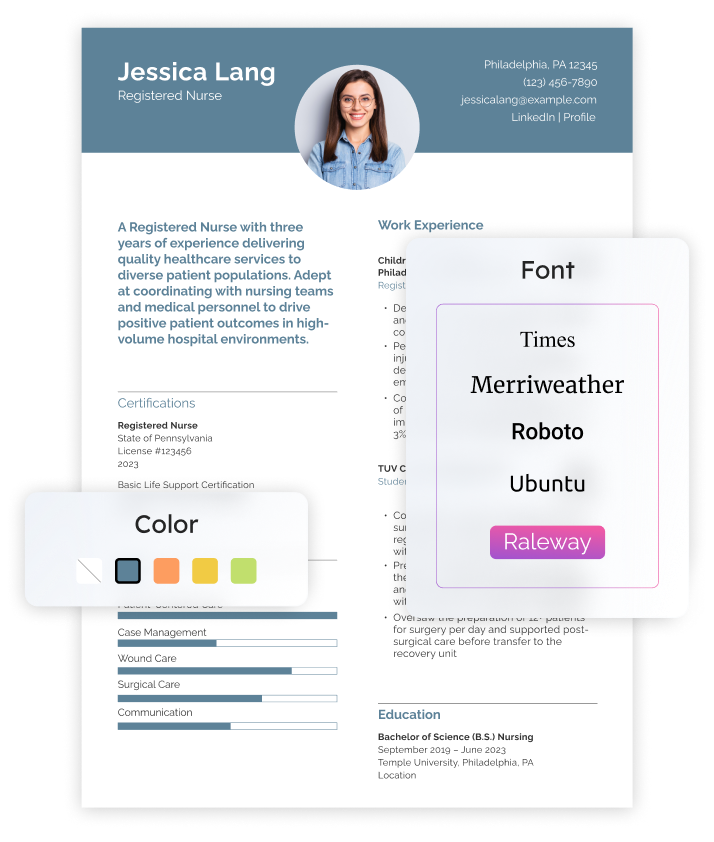
Unless a photo is specifically expected for your profession or required in the country where you’re applying, leave it off your resume.
Photos, age, marital status, and other personal details generally don’t help employers evaluate your qualifications and can distract from what matters for your candidacy.
Keep the focus on professional information, such as your experience, skills, education, certifications, and accomplishments. Limit your contact information to what an employer needs to reach you, such as your phone number, email address, city and state, and LinkedIn profile.
2. Using Overdesigned Resume Templates
A resume doesn’t need elaborate graphics or decorative elements to stand out. Overdesigned templates can distract from your qualifications and make key information harder to find.
Skip design elements such as:
- Large graphics or charts
- Decorative icons and excessive color
- Multiple columns with limited space
- Unusual fonts or difficult-to-read layouts
Instead, use a clean layout with clear section headings, consistent spacing, and an easy-to-read font. Professional formatting should support your content rather than compete with it.
3. Including Professional References
There’s generally no reason to include references on your resume or the phrase “References available upon request.” Employers know they can request references later in the hiring process, and using resume space for them takes attention away from your qualifications.
Tip!
Tip!
Keep your references in a separate document and provide them when an employer specifically asks. This also gives you an opportunity to confirm that each reference is still willing to speak on your behalf and has your current contact information.
4. Adding Your Entire Career History
Your resume doesn’t need to document every job you’ve held. Focusing on roughly the past 10 to 15 years gives you enough space to show relevant experience without turning your resume into a complete employment record.
Older positions can usually be shortened or removed when they no longer support your current career goals. Prioritize experience that:
- Relates to the position you are targeting
- Demonstrates transferable or specialized skills
- Shows career progression
- Includes meaningful accomplishments
You can mention earlier experience briefly when it provides important context for your career or directly relates to the position.
For example, an IT professional with 18 years of experience could list a relevant role from 2005 to 2010 in a brief “Additional Experience” section rather than including several detailed bullets:
Additional Experience
IT Support Specialist | Northwest Medical Systems | 2005–2010
Provided technical support and network troubleshooting for a 200-user healthcare organization.
5. Listing Outdated Software, Tools, & Skills
Skills that were valuable a few years ago may no longer strengthen your resume, especially when newer tools have become standard in your field.
Review your skills section regularly and remove technologies, software, and technical skills that are obsolete or no longer relevant to the jobs you want.
Prioritize current tools and skills that appear in the job descriptions you’re targeting and that you can demonstrate through your recent experience. If a skill is no longer used in your industry, replacing it with a current, relevant competency can make better use of limited resume space.
Tailoring Resume Trends Across Industries & Career Levels
Resume trends don’t look the same across every industry or career stage. The strongest resumes reflect what employers in a particular field want and give more weight to the skills, results, and responsibilities that come with experience.
The examples below show how that strategy can change from entry-level to experienced to executive roles—and what makes each approach effective in 2026.
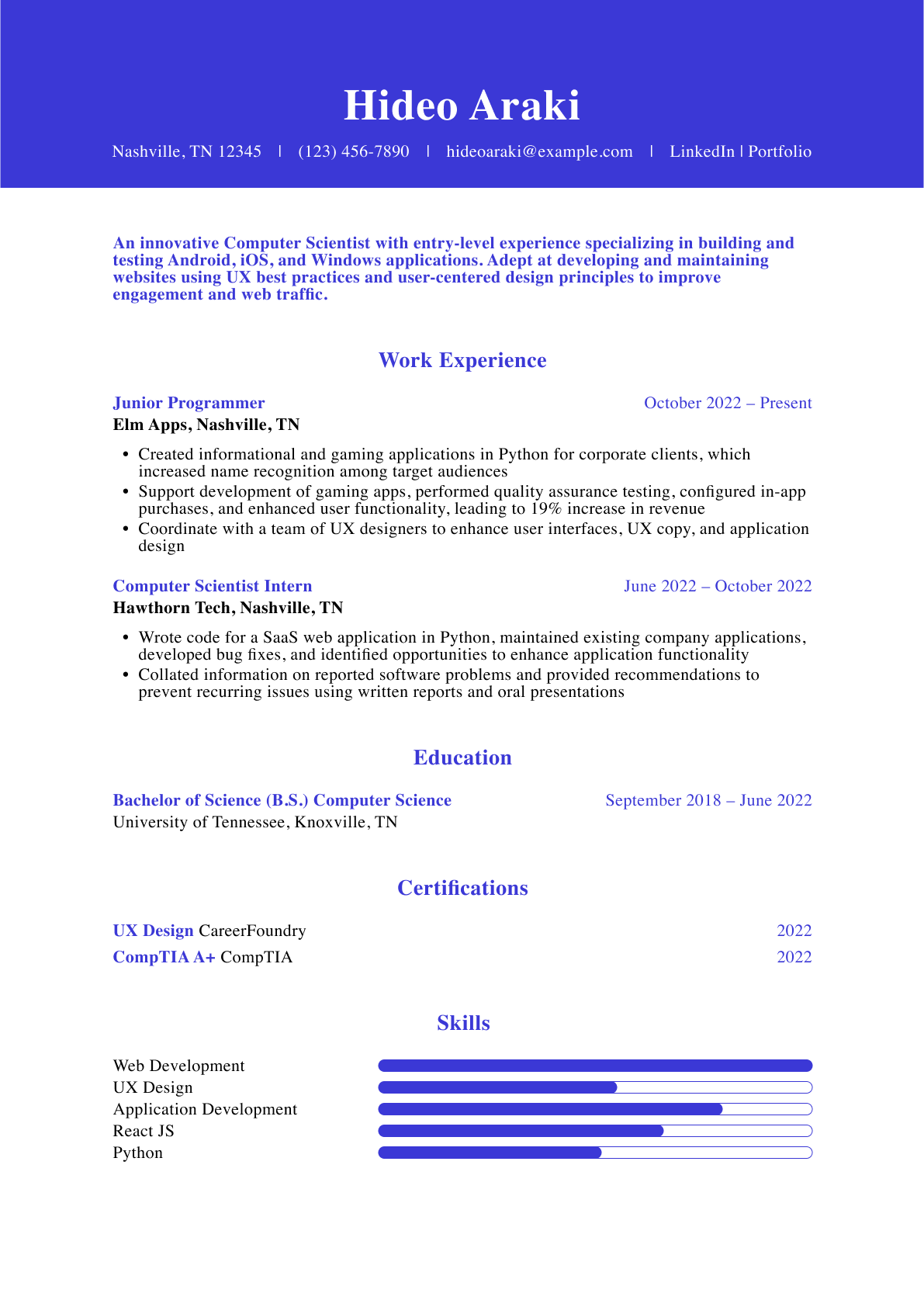
Entry-Level Software Engineer Resume


Why This Resume Works
- Leads with relevant technical skills: This resume makes the candidate’s core technologies easy to find, including JavaScript, Python, React, Docker, and GitHub. This helps both ATS software and recruiters quickly identify relevant qualifications.
- Connects technical work to measurable results: Rather than simply listing responsibilities, the experience section shows outcomes, such as reducing API response times by 25% and cutting deployment time by 30%.
- Shows progression without overloading the resume: The three roles show growth from internship to associate software engineer to software engineer, with each position highlighting concrete contributions. For an early-career candidate, this gives employers evidence of increasing technical responsibility and practical experience.
Clinical Operations Manager Resume

Why This Resume Works
- Leads with measurable operational impact: The summary and work history quickly show results that matter in healthcare operations, including an 18% reduction in operating costs, 25% greater workflow efficiency, and 22% higher appointment capacity. These metrics give employers a clear sense of the candidate’s value.
- Highlights industry-specific expertise: HIPAA and OSHA compliance, quality assurance, clinical operations, and healthcare certifications are prominently featured.
- Demonstrates increasing leadership responsibility: The career history shows a clear progression from Clinical Coordinator to Supervisor to Manager, with responsibility growing from supporting a 25-person care team to overseeing 65+ employees across four departments, creating a stronger leadership narrative than a list of duties alone.
VP of Sales Resume

Why This Resume Works
- Leads with business-level outcomes: The resume focuses on metrics executives are expected to influence, including $82M in revenue responsibility, 28% revenue growth, a 9-point margin improvement, and $14M in new annual revenue. These results show the scope and financial impact of the candidate’s leadership.
- Emphasizes strategic and organizational leadership: Rather than focusing on day-to-day sales activities, the experience highlights P&L management, market expansion, organizational scaling, forecasting, and succession planning. That shift reflects what employers expect from a VP-level candidate.
- Shows a clear progression toward executive responsibility: The career history moves from Sales Director to Senior Director to VP of Sales, with increasing team size, revenue ownership, and strategic influence at each level. This creates a concise leadership narrative while showing how the candidate’s scope has expanded over time.
Key Takeaways
- Use a clean, ATS-friendly resume format. Keep your layout simple, use standard section headings, and make your experience easy for both screening software and recruiters to scan.
- Tailor your resume to every job you apply for. Match relevant skills and terminology from the job description to your actual experience, then show how you used those skills and what you accomplished.
- Show measurable impact instead of listing duties. Strengthen your work history with specific accomplishments, numbers, percentages, or other evidence that demonstrates the results of your work.
- Keep your skills and experience current. Highlight relevant AI, technology, and industry skills, while removing outdated tools, unnecessary personal details, references, and older experience that no longer supports your career goals.
- Use AI as a tool, not a substitute for your experience. AI can help tailor and improve your resume, but every claim, skill, accomplishment, and qualification should accurately reflect your background.
Frequently Asked Questions
What do resumes look like now in 2026?
Resumes in 2026 are clean, focused, and tailored to the specific job. Most use a simple, ATS-friendly layout with clear section headings, concise accomplishment-focused bullets, relevant keywords, and measurable results. Modern resumes also highlight current skills, including AI and technology skills when relevant, rather than relying on outdated objectives, lengthy career histories, or decorative design elements.
What type of resume do employers now prefer?
The type of resume employers generally prefer is a clear, tailored reverse-chronological resume with a simple, machine-readable layout. This is a strong choice for most candidates because it clearly shows recent experience, career progression, relevant skills, and measurable accomplishments.
Are one-page resumes still preferred?
One-page resumes are still preferred for many candidates, especially students, recent graduates, and professionals with less than 10 years of relevant experience. A two-page resume may be appropriate when you have enough relevant experience to justify the additional space. The goal is to keep your resume concise and focused rather than forcing your experience into one page.
How is AI changing resumes?
AI is changing resumes by making tailored content, relevant skills, and clear evidence of results more important. Employers increasingly use AI-assisted tools to help organize and evaluate applications, while job seekers use AI to draft and customize resumes. If you use AI tools for support, your resume should still accurately reflect your experience, use job-relevant language naturally, and show how you applied your skills.
Why is it so hard to get a job right now in 2026?
Getting a job in 2026 can be difficult because many openings attract large applicant pools, while employers use ATS and AI-assisted tools to manage applications and identify qualified candidates. Job seekers also face competition from candidates who use AI tools to apply faster and tailor their applications. As a result, relevant experience, clear qualifications, and targeted resumes matter more than ever.
Craft your perfect resume in minutes
Get 2x more interviews with Resume Builder. Access Pro Plan features for a limited time!